Check availability

Three simple steps. That's it.

Pick your dates, a pod, and who you want to go with. If your preferred pod or dates aren't available we will show you other options to get you there.

Book now and pay later with WanderPay · Payment option available at check out

⸻ destination guide

Kangaroo Island,
at your own pace

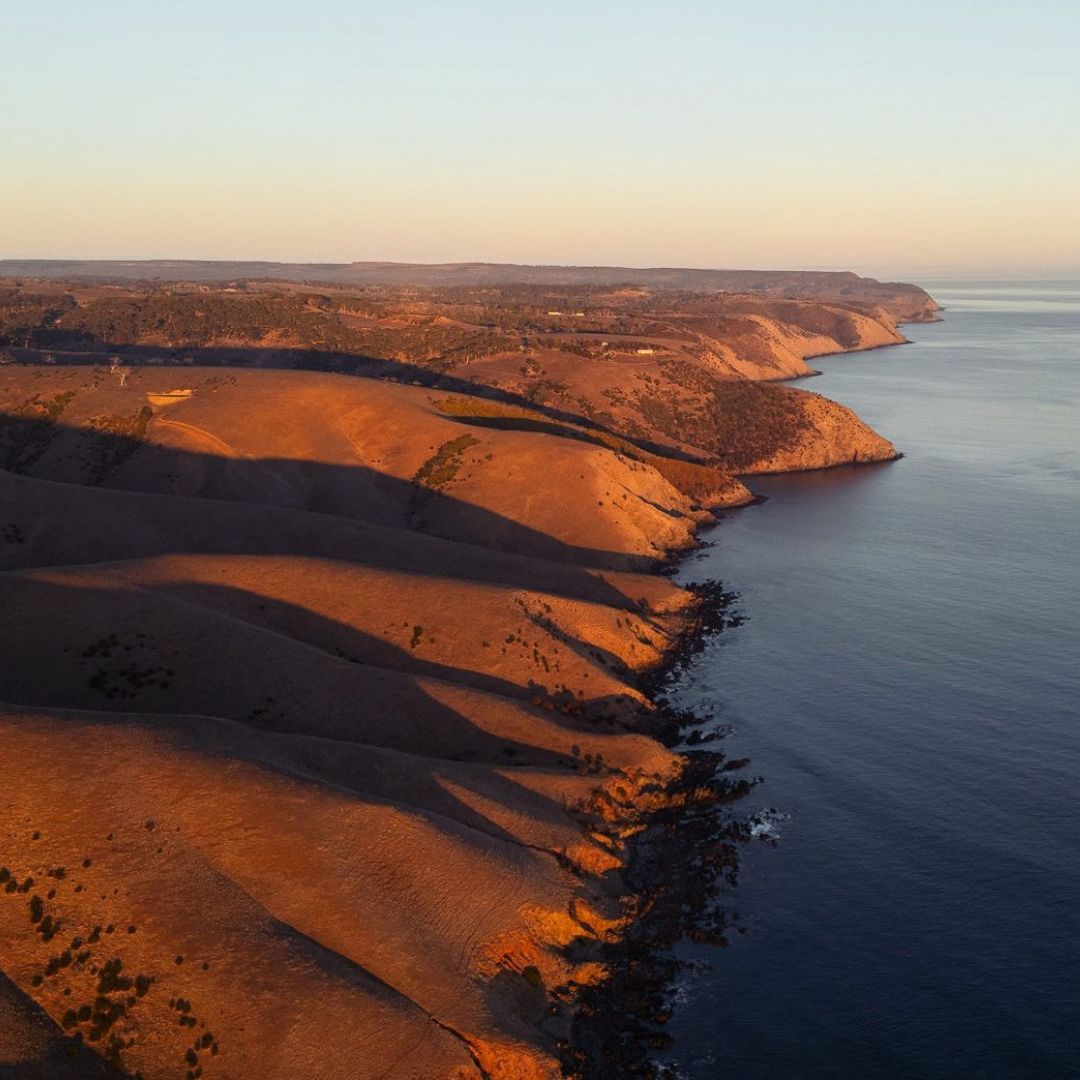
South Australia's island of wild sea lions, wind-carved coastlines and some of the best beaches in the country.

Last reviewed · August 2026

Written by Cassandra Sasso, Founder & CEO
  • !
    Overview
  • !
    Getting there
  • !
    When to visit
  • !
    Things to do
  • !
    Wildlife
  • !
    Food & wine
  • !
    Itineraries
  • !
    Insider tips
  • !
    Land & conservation
  • !
    FAQ's

⸻ At a glance

About Kangaroo Island 

Where

Off the coast of South Australia, ~112 km southwest of Adelaide

Traditional name & Country

Karta Pintingga ('Island of the Dead'); Ramindjeri, Ngarrindjeri, Kaurna, Narungga and Barngarla peoples

Size

4,405 km² — Australia's third-largest island and nearly seven times the size of Singapore

Getting there

~45-minute ferry (Cape Jervis to Penneshaw) or a ~45-minute flight from Adelaide

Best time to visit

Year-round; May–September for whales, summer for beaches, winter–spring for green landscapes and active wildlife

How long to stay

2 nights minimum. 3–4 nights is best to visit without rushing. 5+ nights and you'll feel like a new human

Known for

Empty beaches, Australian sea lions at Seal Bay, Flinders Chase National Park, Remarkable Rocks, Ligurian honey, island wine and spirits

⸻ Overview

Where is Kangaroo Island, and why visit?

Kangaroo Island lies about 112 kilometres southwest of Adelaide, separated from the mainland by a stretch of open water called Backstairs Passage. At 4,405 square kilometres it is Australia's third-largest island, and about six times the size of Singapore — around 145 kilometres end to end, yet home to fewer than 5,000 people. 

"An island the size of a small country, with the population of a country town."

That space is not empty; it is full of the things most of Australia has quietly lost. More than a third of the island is protected in national and conservation parks. Sea lions haul out on beaches with no fences and no turnstiles, and the animals you would queue behind glass to glimpse on the mainland simply live here, going about their business while you go about yours. If you'd rather feel that space than read about it, see our off-grid stays on Kangaroo Island.

⸻ Getting there

How do you get to Kangaroo Island?

There are two ways across the water: a 45-minute vehicle ferry from Cape Jervis to Penneshaw, or a flight of around 30-45 minutes from Adelaide to Kingscote. 

01 — Ferry

The Sealink ferry

SeaLink runs the vehicle-and-passenger ferry across Backstairs Passage in about 45 minutes, with up to twelve return sailings a day in peak periods. Book well ahead, especially for a car on a summer weekend as the ferry regularly books out. Allow 1.5–2 hours for the scenic drive down from Adelaide through McLaren Vale.  Plan to arrive to the ferry terminal ~30mins before your departure.

02 — Flight

Flying to Kangaroo Island

QantasLink flies Adelaide to Kingscote in about 30-45 minutes, with several services most days. Flying makes sense if you're tight on time or not bringing a vehicle — but Kingscote Airport is a fair drive from the main sights, so you'll want a hire car regardless.  You can pre-book a hire car at Kingscote airport before you arrive.  Hire cars regularly book out in the summer months so we suggst you plan well ahead. 

03 — On island

Getting around the island

You will need a vehicle. The spine linking Penneshaw, Kingscote and the run west is sealed and straightforward, but many of the roads to the best locations on the island turn to graded gravel — drop your speed, brake gently, and watch for wildlife. Above all, plan your driving around daylight.

⸻ When to visit

When is the best time to visit Kangaroo Island?

A genuine year-round destination — summer for beaches and long golden evenings, autumn for calm seas and empty trails, winter for whales and the greenest landscape, spring for wildflowers and newborn wildlife. There's no bad season, only different ones. For more on travelling gently through the year, read our note on slowing down.

Dec–Feb

Summer

Warm, dry and busiest — 24–25°C, beaches at their best, wildlife theatre at its most dramatic. Book the ferry, tours and stays well ahead.

Mar–May

Autumn

Quietly the island's finest season. Glassy seas, thinning crowds, prime walking weather, water still warm enough to swim into March.

Jun–Aug

Winter

Cool, green and underrated — highs near 15°C, an emerald countryside, wildlife at its most active. Whale season, and a fire to come home to.

Sep–Nov

Spring

Wattle gold, native orchids and the first lavender, with newborn wildlife everywhere. A lovely, uncrowded window before summer.

When can you see whales on Kangaroo Island?

Whale season runs roughly May to September, when southern right and humpback whales move along the coast. Here it's a patient, land-based, free affair: find a headland (Penneshaw, Nepean Bay, Cape Willoughby, the Vivonne Bay and Seal Bay coast) where you can settle in, and scan. Bring binoculars, a thermos and no expectations, then let the ocean surprise you.

⸻ Things to do

What are the best things to do on Kangaroo Island?

The headline experiences gather around the national parks, the wildlife and the coast: Flinders Chase in the west, the sea lion colony at Seal Bay, the dunes of Little Sahara, and a string of beaches good enough to plan a trip around. We go deeper on the parks in our field notes from Flinders Chase.

Flinders Chase National Park

The flagship park and keeper of the island's most famous landmarks, reopened progressively after the fires around the new Karatta visitor centre. A park entry fee applies and you'll want the best part of a day. The single most useful piece of planning advice: do not plan a visit to the park on your day of arrival or departure as there is a decent amount of driving involved and you don't want to rush it.

Remarkable Rocks & Admirals Arch

Vast granite boulders hollowed by wind and salt into sculpted shapes above the Southern Ocean — come in the low, warm light of late afternoon and the granite glows orange against the blue. A short drive away, Admirals Arch frames the sea beneath a heritage lighthouse, with a resident colony of long-nosed fur seals hauled out on the rocks below.

Beaches, dunes and caves

Stokes Bay — a north-coast sleeper, its hidden main beach reached through a tunnel between the boulders; a sheltered rock pool on the far side.

Vivonne Bay — a long, white Southern Ocean beach, with safer swimming tucked near the jetty.

Emu Bay — a calm four-kilometre arc where dolphins are a regular sight.

Little Sahara — a startling sea of white dunes; hire a board and toboggan the slopes.

Kelly Hill Caves — a dry limestone cave system explored on guided tours, reopened after the fires.

⸻ Wildlife

What wildlife can you see on Kangaroo Island?

One of the great wildlife destinations in Australia. Australian sea lions, kangaroos, koalas, echidnas, fur seals, glossy black-cockatoos and seasonal whales, several found here in forms that exist nowhere else on earth. The island's long isolation has been an evolutionary workshop. For how these species are protected, read the conservation story here.

Seal Bay — walking among wild sea lions

Seal Bay protects one of the most significant Australian sea lion colonies in the world — the third-largest anywhere, around 800 animals. This is one of very few places on the planet where you can walk out onto the beach among wild sea lions, accompanied by a National Parks guide, as they doze on the sand and come lolloping out of the surf. Carry one sobering fact: the Australian sea lion is endangered and still declining — keep the distances your guide sets, and let the animals set the terms.

Kangaroos, koalas and echidnas

The Kangaroo Island kangaroo is a distinct subspecies — shorter, stockier and darker than its mainland cousins. Koalas, introduced in the 1920s, are recovering after the fires and still seen draped in the manna gums around Hanson Bay. The endangered Kangaroo Island echidna is the connoisseur's sighting: a shuffling ball of spines in the leaf litter, wonderfully unbothered by an audience.

Fur seals, birds and the glossy black-cockatoo

At Admirals Arch, long-nosed fur seals sprawl across the rocks in the spray. Birdwatchers should look for the endangered glossy black-cockatoo, an island subspecies whose recovery is a genuine conservation triumph — lifted from 158 birds in 1995 to more than 450 today. Little penguin colonies have declined sharply, so an evening sighting is now a bonus rather than a certainty.

Stargazing

With almost no light pollution particularly at the western end, the island delivers the kind of night sky most of us have forgotten exists. On a clear, moonless night the Milky Way arcs from horizon to horizon. Pack a rug and let your eyes adjust for a full twenty minutes.

⸻ Food & wine

What is Kangaroo Island known for in food and wine?

The island is a leading regional food destination in Australia — Ligurian honey, island wines and gin, fresh seafood, and farm-gate producers you can taste from directly. The island's isolation keeps provenance tight and flavours honest. Here, 'local' is a distance measured in paddocks. Meet a few of them in our journal on the island's producers.

Honey

A world-first bee sanctuary

The island protects the world's purest surviving strain of Ligurian bees, safeguarded here since 1885 — the oldest such sanctuary anywhere. Taste the honey, including the honey ice cream, at Island Beehive in Kingscote and Clifford's Honey Farm.

Wine & gin

Small cellar doors, big views

Kangaroo Island Spirits pours gins built on wild-harvested coastal botanicals. For wine, seek out Dudley Wines — one of the great tasting views in the state — along with False Cape, Springs Road and Bay of Shoals. Round it out with a local beer or cider, the sea in view.

The larder

Seafood, cheese and more

Marron with butter and lemon, local oysters, rock lobster and King George whiting straight off the boats; cold-pressed olive oil, eucalyptus oil and lavender. Give yourself a long, unhurried ocean-view lunch and let the island feed you.

⸻ Itineraries

Kangaroo Island itineraries: how many days do you
need?

Two full days is the realistic minimum; three to four lets you reach both the wildlife-rich east and the wild west. Allow 2–2.5 hours to drive Penneshaw to Flinders Chase — so plan your days geographically, moving in one direction rather than darting back and forth. 

48 hours

The Taster Trip

Stay east and central and resist the far west. Day one: arrive at Penneshaw, a tasting and the view at Dudley Wines, then Cape Willoughby lighthouse. Day two: a walk among the sea lions at Seal Bay, the dunes at Little Sahara, a swim at Vivonne Bay, and dinner back around Kingscote.

3–4 days

The long weekend

A third day earns you the national park in the west. Follow the 48-hour plan, then head out to Flinders Chase for Remarkable Rocks, Admirals Arch, Cape du Couedic and Kelly Hill Caves, watching the canopy around Hanson Bay for koalas. Wander is located central to both the east and west itineraries, making it the perfect island base. 

5+ days

The full loop and time to reset

The island seen properly, with enough time to take it slowly. Work steadily east to west — Dudley Peninsula and Cape Willoughby, the central belt, then the west for Flinders Chase and the coast, before curling home along the north shore via Stokes Bay and Emu Bay. Keen walkers can fold in sections of the island's trails.

⸻ From the Wander team

Insider tips for Kangaroo Island

The difference between a good trip and a great one comes down to a handful of things the map won't tell you. These are the things we find ourselves telling guests before they set off. More of our thinking on unhurried travel lives under Slowing Down.

Two nights is rarely enough 

The island is huge and you'll be driving a distance.  Its a place to take your time.  Clear the calendar for a day or two longer and you wont regret it.    

Timing the icons

Remarkable Rocks and Admirals Arch are transformed by low light. The granite warms to amber, the seals grow active, the crowds thin. Plan your western day backwards from sunset.

Avoid driving at night

Wildlife moves onto the roads at dusk, and collisions are common and distressing. Try to be off the road by nightfall, and eat where you stay.  This is especially important on your arrival day when you are still orientating yourself. 

Book the Seal Bay guided walk

The boardwalk is lovely, but the guided beach walk — down on the sand among the colony — is the once-you'll-remember part. It's capped and popular, so book ahead.  

Stock up and fuel up

Services thin out dramatically past the central towns. Top up the tank in Kingscote or Penneshaw and don't assume you'll pass a servo.  Restaurants and coffee shops are few and far between out west. 

Consider off-season

March to May gives calm, clear seas, warm-enough water, thin crowds and the island much as the locals know it. Don't write off winter, either the skies are incredible and the weather is perfect for settling in. 

⸻ Practical tips

Practical tips for visiting Kangaroo Island

A little planning goes a long way. Book the ferry and key tours well ahead, fuel up in the main towns, avoid driving at night, and don't count on constant mobile coverage.

Towns, fuel and supplies

The main townships are Kingscote (the largest), Penneshaw (the ferry port), American River and Parndana (central). Treat the west as remote country and fill up and stock up before you head out.

Mobile coverage

Reception is patchy and drops out entirely across much of the rural island. Download maps for offline use, tell someone your plan and treat the disconnection as a feature, not a fault.

Driving dirt roads

Many of the public roads on the island are not sealed. If you remember one thing: slow right down on the gravel roads, and try to be off the roads by nightfall.

What to pack

Layers whatever the season, serious sun protection year-round, sturdy shoes, and wet-weather gear in winter and spring if you want to venture out. Binoculars earn their place for stargazing.

Can you bring a dog?

Dogs are generally not permitted in the national and conservation parks, to protect native wildlife. Check current NPWS South Australia rules and choose dog-friendly options outside protected areas.

⸻ Land & conservation

The land, culture and conservation of Kangaroo Island

In this simple yet evocative image, a person's hand comes into focus, gently cradling a piece of Kangaroo Island's earth – a rock or a fragment of its rustic terrain. This image captures the intimate connection between the individual and the island's natural beauty.

First peoples and the island's name

Karta Pintingga — 'Island of the Dead' — comes from the Kaurna language, and the island is connected to the Ramindjeri, Ngarrindjeri, Kaurna, Narungga and Barngarla peoples. Stone tools at Rocky River show occupation reaching back thousands of years, from before rising seas cut the island from the mainland. By the time Europeans arrived in 1802 it was uninhabited; how long before, and why, remains genuinely uncertain, and a reason the name carries the weight it does.

Conservation on the island

More than a third of the island is protected, its conservation led by the Kangaroo Island Landscape Board and National Parks and Wildlife Service SA. Their work is the reason so much still exists — the glossy black-cockatoo recovery, the predator control standing between the little penguins and local extinction, and the vast post-bushfire restoration. None of it is finished, and all of it is fragile.

Travelling responsibly

Tread lightly. Keep to the tracks, keep the wildlife at a distance, and put your money toward the local operators and producers who keep the island's economy and its conservation intertwined. Wander, for its part, uses local suppliers, is a certified B Corporation and donates $10 from every direct booking to Bush Heritage Australia.

⸻ STAY ON KANGAROO ISLAND

Stay off-grid with Wander

Wander has four off-grid WanderPods® on Kangaroo Island — architect-designed, and set above rich coastal waters where dolphins pass below. No televisions, no crowds; the design is pared back so the view, the weather and the quiet do the work a screen usually does.

Every stay comes with a curated guide to the island's producers, walks and wildlife — the same local knowledge that runs through this guide — and $10 from every direct booking goes to Bush Heritage Australia.

⸻ Faq

Kangaroo Island FAQs

How do you get to Kangaroo Island?

By a 45-minute SeaLink ferry from Cape Jervis to Penneshaw, or a roughly 30-45 minute Qantas flight from Adelaide
to Kingscote. Most visitors take the ferry so they can bring a car, otherwise you can hire a car at Kingscote Airport.

When can you see whales on Kangaroo Island?

From roughly May to September, when southern right and humpback whales pass the coast; watch from headlands such as Penneshaw and Cape Willoughby.

Can you walk with sea lions at Seal Bay?

Yes — guided beach walks take you among a wild Australian sea lion colony (the third-largest in the world),
with a boardwalk alternative for accessible viewing.

Do you need a car on Kangaroo Island?

Effectively yes. The island is about 145 km end to end with no public transport, taxis or ride-sharing, so most visitors bring a car on
the ferry or hire one on arrival.

What is the Aboriginal name for Kangaroo Island?

Karta Pintingga, meaning 'Island of the Dead,' from the Kaurna language.

Can you bring a dog to Kangaroo Island?

Dogs are generally not allowed in the island's national and conservation parks; check current NPWS South
Australia rules and choose dog-friendly options outside protected areas.

Is Kangaroo Island still recovering from the Black Summer bushfires?

Yes, and by now the recovery is well advanced. The Black Summer fires burnt around 52% of the island, falling hardest on the west, where roughly 96% of Flinders Chase National Park was affected. But the eastern and central island came through largely untouched, and the west has since reopened and regrown — a new visitor centre opened at Karatta in 2024. What you'll see out west today is not a scar but a landscape regenerating. 

⸻ About this guide

This guide was written and fact-checked by the Wander team, who host guests on Karta Pintingga, Kangaroo Island, South Australia. We review it each season for accuracy.

⸻ Sources & further reading

Compiled from official tourism, national park and conservation sources, cross-checked for accuracy: Tourism Kangaroo Island, the South Australian Tourism Commission, National Parks and Wildlife Service SA, SeaLink, Qantas, the Kangaroo Island Landscape Board, DCCEEW, Island Beehive and Clifford's Honey Farm, and Bush Heritage Australia. Fares, park fees and wildlife conditions change over time; confirm specifics before you travel.